Screw Elevator vs Hydraulic Elevator vs Traction Elevator:Which Home Elevator Is Better?
Picking a home elevator is never just about looks or price.
Different elevator types vary a lot in installation needs, riding comfort, maintenance expenses and space occupation.
For home use, screw, hydraulic and traction elevators are the three mainstream choices.
Each has its own unique strengths. Which one fits you best simply depends on your house structure, budget and daily usage needs.
In this guide, we’ll compare these elevator types in a simple and practical way to help you find the right solution for your project.
About
Screw Elevator:
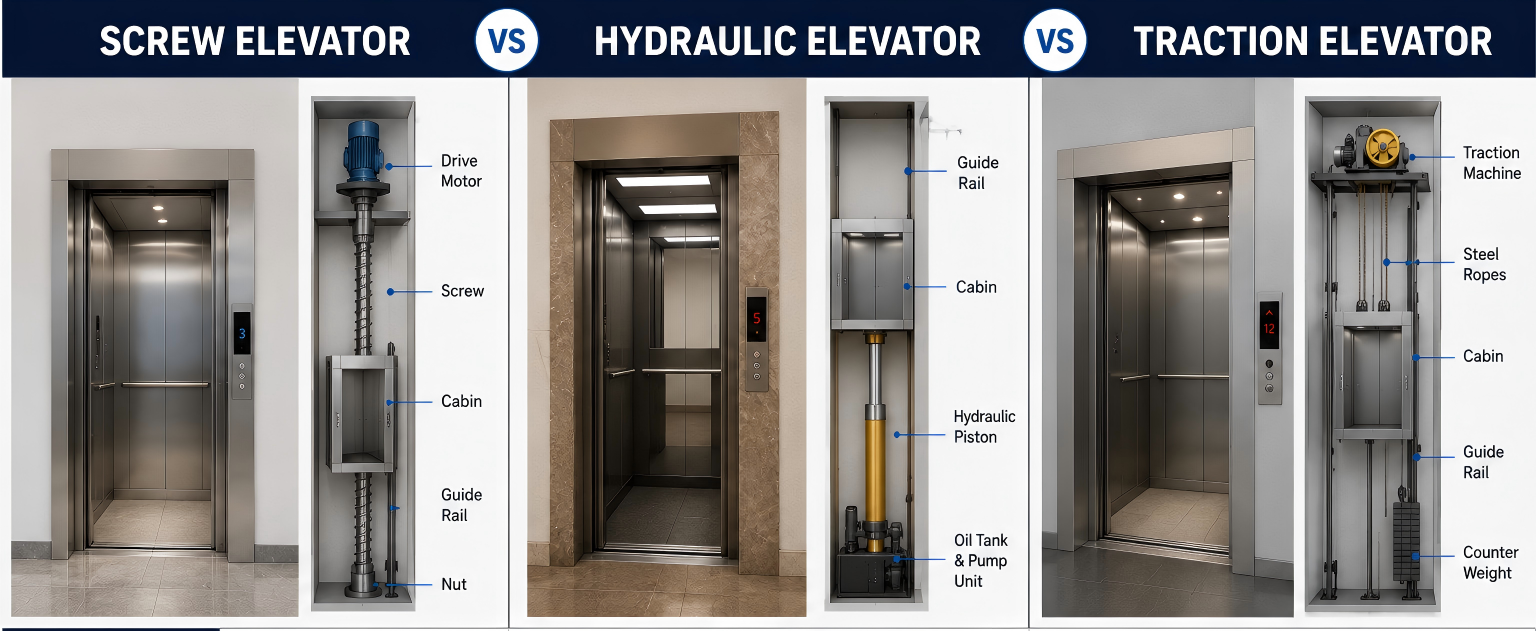
Screw elevator is a compact home elevator driven by a screw and nut system. The motor rotates the nut along the fixed screw to move the platform or cabin up and down.
Unlike traditional elevators, screw elevators do not require:
- Counterweights
- Steel ropes
- Large machine rooms
Because of their compact structure, they are especially suitable for:
- Villas
- Duplex houses
- Old house renovation projects
- Homes with limited installation space
One of the biggest advantages of screw elevators is flexibility.
They can often be installed with little or no pit requirement, making installation easier in existing homes.
However, screw elevators usually run slower and may produce more mechanical noise compared with traction elevators.
Hydraulic Elevator:
Hydraulic elevators rely on hydraulic oil pressure to move the car up and down.
The hydraulic pump pushes oil into the cylinder, which drives the piston to lift the elevator. When going down, the oil flows back to the tank, letting the car glide down steadily and smoothly.
Hydraulic elevators used to be super popular across Europe and North America, especially for low-rise private homes.
Its key benefits are as follows:
- Strong lifting capacity
- Lower civil construction requirements
- Stable operation for low floors
For projects that need to transport heavier loads at lower heights, hydraulic elevators can still be a practical solution.
However, compared with modern traction elevators, hydraulic systems usually consume more energy and require more maintenance over time.Oil leakage and pump noise are also concerns that some homeowners consider before choosing this type.
Traction Elevator
Traction elevators are by far the most common option for both homes and commercial buildings these days.
They run with a traction machine, steel ropes or belts, plus a counterweight system. The counterweight balances the weight of the elevator car, making the whole ride much smoother and more energy-saving.
Compared with screw and hydraulic elevators, traction elevators come with obvious perks:
- Faster running speed
- Much quieter operation
- More comfortable riding experience
- Better energy efficiency
Most modern traction elevators adopt permanent magnet synchronous motors. They cut down power consumption greatly and run far more steadily.
If you value long-term riding comfort and use the elevator very often daily, a traction elevator is always the top pick.
On the flip side, traction elevators do have certain installation requirements:
- Need a standard pit depth
- Require enough top floor height
- Take up more installation space
For this reason, they work best for new-build houses or projects that already meet the civil engineering conditions.
Data
| Type | Screw Elevator | Hydraulic Elevator | Traction Elevator |
| Running speed | 0.15-0.3m/s | 0.3-0.4m/s | 0.4-1.0m/s |
| Load capacity range | 250-400kg | 250-500kg | 400-1000kg |
| Construction Requirements | For bottomless or shallow pits, no machine room is required. | A shallow foundation pit requires no dedicated machine room; only one load-bearing wall is needed. | Standard foundation pit requires reservation of the shaft passage and top-level space. |
| Energy consumption level | medium | on the high side | low |
| Maintenance management | Few vulnerable components, simple maintenance | Regular inspections are required | Regular professional maintenance is required. |
Comparison of Advantages and Disadvantages
Screw Elevator
Advantages:
It makes great use of space and barely needs major construction work.
It locks automatically when power goes out, which adds extra safety.
Maintenance doesn’t cost much, so it’s ideal for fitting into old homes and existing buildings.
Disadvantages:
It runs at a slower speed and isn’t the most efficient for frequent use.
You’ll notice some running noise, and the ride experience is just average.
It also can’t handle heavy load capacity.
Hydraulic Elevator
Advantages:
No strict construction requirements, and no separate machine room is needed.
It has strong load capacity and runs smoothly in low-rise homes, with reliable safety performance.
Disadvantages:
Hydraulic oil may leak over time, creating environmental issues and more maintenance hassle.
It runs quite noisy, uses more electricity, and needs frequent routine upkeep.
Traction Elevator
Advantages:
Super quiet operation and gives you a really smooth, comfortable ride.
It’s power-saving, eco-friendly, and comes with full safety protections.
Perfect for multi-story houses, with fast and efficient running performance.
Disadvantages:
It has high standards for building structure, needing a standard pit, dedicated shaft and enough top-floor space.
It also takes up more room for installation overall.
Which Elevator Is Best for Different Projects?
Screw Elevator Is Suitable For:
- Villas
- Duplex homes
- Old house renovation
- Limited installation space
- Low-frequency usage
If your house cannot create a deep pit or large shaft, screw elevators can be a practical option.
Hydraulic Elevator Is Suitable For:
- Low-rise buildings
- Heavy load requirements
- Projects sensitive to initial cost
- Low-floor transportation
Hydraulic elevators are still useful for some specific low-rise applications.
Traction Elevator Is Suitable For:
- Mid-to-high-end villas
- Frequent daily usage
- Multi-floor houses
- Homeowners seeking comfort and quietness
Traction elevators are generally considered the best long-term solution for modern homes.
Common Mistake When Choosing a Home Elevator
One common mistake is focusing only on initial price.
Some homeowners choose the cheapest option without considering:
- Maintenance cost
- Daily usage frequency
- Future repair expenses
- Installation limitations
In many cases, choosing the right elevator from the beginning can save more money in the long run.
FAQ
- Which elevator type is the quietest?
Traction elevators are by far the quietest choice among all home elevator types.
- Which elevator needs the least installation space?
Screw elevators take up the least space and fit perfectly into tight home layouts.
- Are hydraulic elevators outdated?
Not at all. They’re still widely used in low-rise buildings and projects that need heavy load capacity.
- Which elevator is best for villas?
Most villa owners go with traction elevators, thanks to their great comfort and efficient performance.
- Which elevator type requires the least maintenance?
Screw elevators have a simple structure, so they need far less routine maintenance.
Contact Us
Still do not know which elevator is right for your project?
Do not worry, we can help you choose the most suitable solution based on your building structure, space, and budget.
Contact us today for professional advice and a customized quotation.